

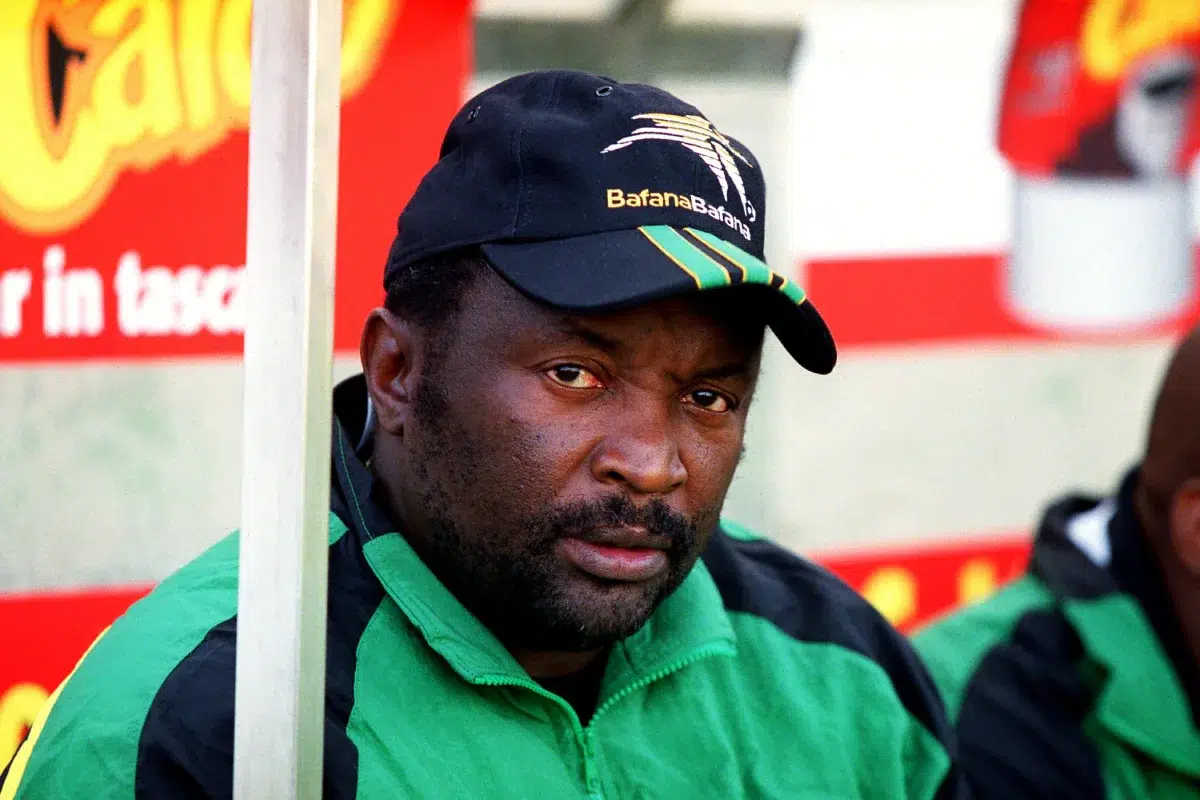
Ephraim Matsilele “Jomo” Sono is one of the most gifted footballers South Africa has ever produced. Renowned for his supreme dribbling skills and visionary passing, he became a global ambassador for the country’s talent during the isolation era. As a player, coach, and club owner, his influence on the local game remains unmatched.
| Attribute | Detail |
|---|---|
| Full Name | Ephraim Matsilele Sono |
| Nationality | South African |
| Date of Birth | 17 July 1955 |
| Latest Club | Retired |
| Shirt Number | 10 |
| Position | Attacking Midfielder / Forward |
Master of the midfield
Sono was a classic number 10 who combined audacious individual skill with the intelligence to orchestrate attacks.
- 🪄 Dribbling wizardry: He possessed close control that allowed him to weave through tight defences with ease.
- 🧠 Vision: His ability to spot a pass before anyone else on the pitch made him a deadly playmaker.
- 🎯 Dead-ball specialist: He was famous for bending free-kicks and delivering pinpoint corners.
- ⚡ Flair: Known for entertaining the crowd, he often performed tricks that demoralised opponents.

A storied club career
From the dusty streets of Soweto to the glamorous stadiums of North America, Sono’s journey was defined by his raw talent and determination. He stood out as a prodigy at Orlando Pirates before showcasing his ability alongside the world’s best players in the United States.
Rise at Orlando Pirates
Sono began his professional life at Orlando Pirates, the club his father, Eric “Scara” Sono, had captained. He filled the void left by his father’s tragic death with performances that bordered on the magical. His impact was immediate, and he quickly earned the nickname “Jomo” (meaning “Burning Spear”) from fans who compared his leadership to Kenyan leader Jomo Kenyatta.
During the 1970s, he formed a lethal combination with other Soweto giants. His flair and goal-scoring ability helped the Buccaneers dominate local competitions. He became the face of black South African football, drawing huge crowds whenever he played. His success at Pirates eventually attracted interest from overseas, paving the way for his move to the North American Soccer League (NASL).
Conquering North America
In 1977, Sono joined the New York Cosmos, arguably the most famous club in the world at the time. He played alongside legends like Pelé and Franz Beckenbauer, proving he belonged among the elite. Although his time in New York was short, he left a lasting impression before moving to other NASL teams.
He enjoyed significant success with Toronto Blizzard and the Atlanta Chiefs, where he teamed up with fellow South African icon Kaizer Motaung. In Toronto, he became a key attacking figure, scoring regularly and providing assists. After his American adventure, he returned to South Africa to purchase Highlands Park, renaming it Jomo Cosmos, where he transitioned into a player-coach role to end his playing days.
| Team (Appea.) | G/A/YC/RC |
|---|---|
| New York Cosmos (12) | 1/0/N/A |
| Colorado Caribous (30) | 8/5/N/A |
| Atlanta Chiefs (29) | 5/12/N/A |
| Toronto Blizzard (57) | 22/16/N/A |
International isolation and coaching redemption
Sono’s international playing career was tragically curtailed by the apartheid regime, which resulted in South Africa’s suspension from FIFA. He never had the opportunity to represent a unified South African nation in a World Cup or AFCON tournament during his prime. Instead, he featured in various multi-racial invitation XI matches that showcased what the world was missing.
His redemption came as a manager. He led Bafana Bafana to the final of the 1998 Africa Cup of Nations and coached the team at the 2002 FIFA World Cup in South Korea and Japan. While he could not wear the jersey on the global stage, his tactical guidance ensured a new generation of players could fulfill the dreams he was denied.
| Competition (Stage) | MP (Goal) |
|---|---|
| Official FIFA Tournaments | N/A (N/A) |
Timeline of clubs
Sono’s career took him from the heights of American soccer back to his roots in South Africa, where he built his own legacy.
He remains one of the few figures to have succeeded as a player, coach, and club owner in the PSL era.
| Years | Club |
|---|---|
| 1970s | Orlando Pirates |
| 1977 | New York Cosmos |
| 1978 | Colorado Caribous |
| 1979 | Atlanta Chiefs |
| 1980–1982 | Toronto Blizzard |
| 1983–Retired | Jomo Cosmos |