


Neil Tovey is widely regarded as one of the most significant figures in South African football history. Affectionately nicknamed “Mokoko,” he famously captained Bafana Bafana to their historic 1996 Africa Cup of Nations triumph on home soil. A versatile midfielder turned world-class sweeper, Tovey spent a decade defining an era at Kaizer Chiefs and remains the only white captain to lift a major continental trophy for the national team.
| Attribute | Detail |
|---|---|
| Full Name | Neil Robert Tovey |
| Nationality | South Africa |
| Date of Birth | 2 July 1962 |
| Latest club | N/A |
| Shirt number | 9 |
| Position | Central Defender / Sweeper |
Playing style: The cerebral sweeper
Tovey was a tactically astute defender who relied on anticipation rather than aggression to neutralize attacks.
- 🧠 Reading of the game allowed him to intercept passes before danger developed.
- 👟 Ball distribution from the back was superior due to his background as a midfielder.
- 🗣️ Organizational leadership ensured his defensive line remained disciplined under pressure.
- 🧊 Composure meant he rarely panicked, often playing his way out of tight situations.
Career journey
From his early days dominating the midfield in Durban to becoming a defensive icon in Soweto, Tovey’s career was marked by consistency and silverware. His transition from an attacking role to a libero extended his longevity and influenced the tactical landscape of local football.
Early years: Durban City and AmaZulu
Born in Pretoria but raised in Durban, Tovey began his professional journey with Durban City in 1981. He quickly established himself as a dynamic midfielder, helping the club win back-to-back NPSL titles in 1982 and 1983 under coach Clive Barker. His ability to score goals from deep made him a standout performer in the coastal league.
In 1986, he moved to local rivals AmaZulu, where he continued to flourish. During his time with Usuthu, he famously scored in a 5-1 demolition of his future employers, Kaizer Chiefs. His performances in Durban cemented his reputation as one of the most complete footballers in the country before the biggest move of his career materialized.
The Kaizer Chiefs era
Tovey joined the Soweto giants in 1990 and would spend the next decade etching his name into club folklore. Unusually for a defender, he famously wore the number 9 jersey, a quirk that became his trademark at the club. It was here that he fully transitioned into the “sweeper” role, marshalling the defense with effortless authority.
During his ten-year stay, he made a record-breaking number of appearances and captained the side to numerous trophies. His leadership was instrumental in the club’s dominance during the 1990s. Tovey played his final match in 1999, retiring as a true Amakhosi legend who had bridged the gap between different eras of South African football.
| Team (Appea.) | G/A/YC/RC |
|---|---|
| Durban City (176) | 17/N/A/N/A/N/A |
| AmaZulu (117) | 14/N/A/N/A/N/A |
| Kaizer Chiefs (341) | 27/N/A/N/A/N/A |
International glory and AFCON 1996
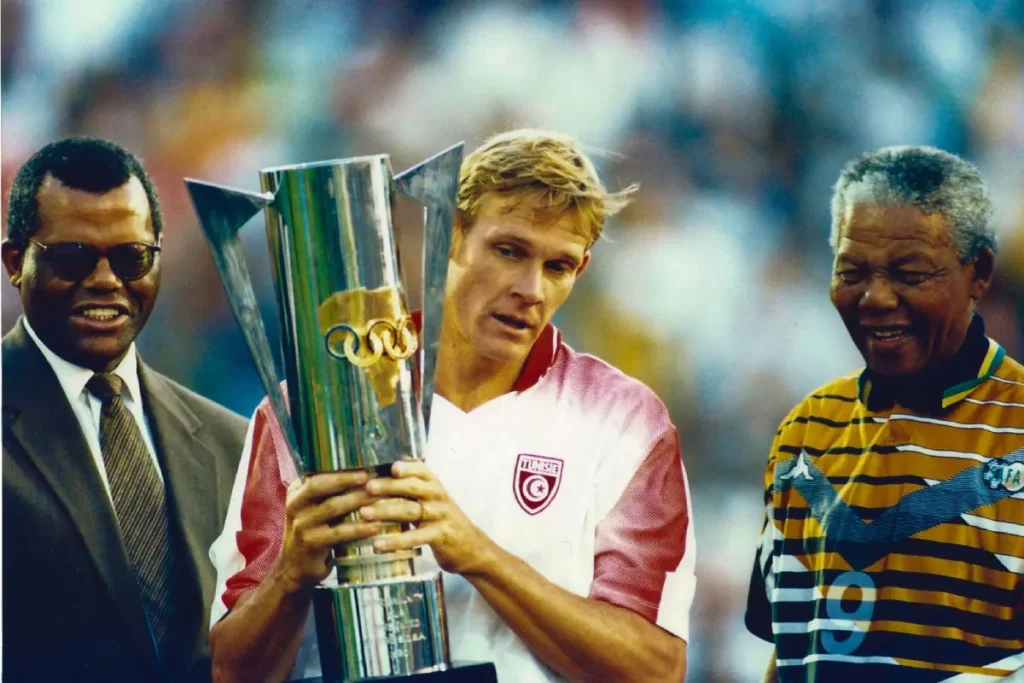
Tovey’s international career is defined by the historic 1996 Africa Cup of Nations. He captained the national team to their first and only continental title, playing every minute of the tournament. The image of Tovey receiving the trophy from President Nelson Mandela remains one of the most powerful symbols of post-apartheid unity in South Africa.
He earned 52 caps for Bafana Bafana, captaining the side 29 times. Although he helped the team qualify for their first World Cup in 1998, he was controversially dropped by coach Philippe Troussier before the final tournament in France. Despite this disappointing end, his legacy as the nation’s “Captain Fantastic” remains untouched.
| Competition (Stage) | MP (Goal) |
|---|---|
| AFCON 1996 (Winner) | 6 (0) |
| FIFA Confederations Cup 1997 (Group Stage) | 3 (0) |
Clubs timeline
Tovey was a model of loyalty, representing just three major clubs over a professional career spanning nearly two decades. He holds the record for the most appearances in the National Soccer League (NSL) era, a testament to his fitness and discipline.
Following his retirement, he transitioned into coaching, managing teams like AmaZulu and Mamelodi Sundowns. However, fans remember him best for his on-field exploits, where he directed play from the back with unique elegance.
| Years | Club |
|---|---|
| 1981–1985 | Durban City |
| 1986–1989 | AmaZulu |
| 1990–1999 | Kaizer Chiefs |